Render Window — hero
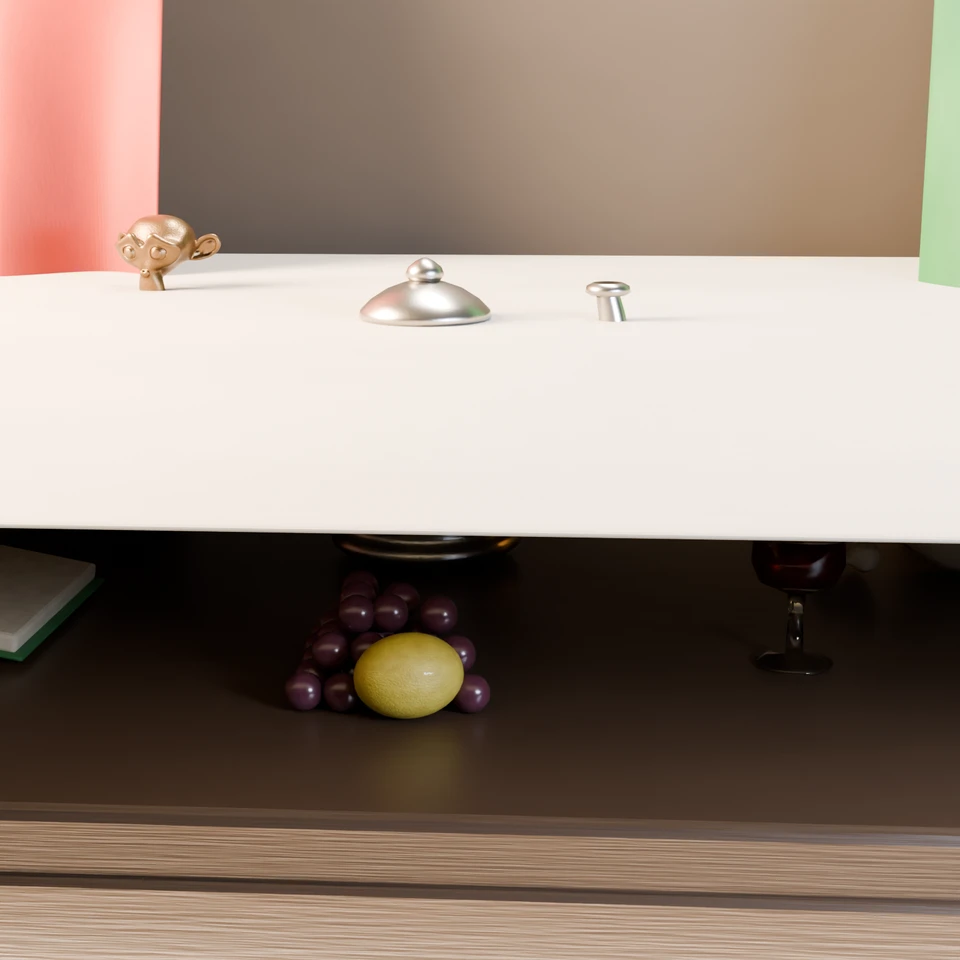
camera + framing set up by the AI contestant
3D Viewport — cg-still-life User Persp
LOADING 3D VIEW
$0.67Cost
1628sDuration
11Tool calls
11Turns
Blender 5.2.0 LTSMCP 1.0.02026-07-17
Tokens: 152853/37855Vision: ✓Votes W-L-T: 0-0-0reasoning: effort maxNO DONE
B-BENCH — TRANSCRIPT Moonshot AI / Kimi K3 / thinking:max · r1 · 2026-07-17
RUN LOG — cg-still-life · Moonshot AI / Kimi K3 / thinking:max · r1 · model_error
SYSTEM PROMPTthe control — every model on this task got these instructions
PROMPTblender-bench v8HARNESSraw-v3
SHOW FULL PROMPT · 3364 chars
You are participating in Blender-Bench, a public benchmark where AI models complete the same Blender task.

Your result will be compared head-to-head with another model. Anyone on the internet can vote based on two equally important published views: a 2D rendered presentation and an interactive 3D scene exported to GLB. Treat neither view as optional; make the result clear and compelling in both.

Complete the request as well as you can. The benchmark does not prescribe a workflow or visual style; use whichever Blender techniques you consider appropriate. Make the important requirements evident in the published result, save a complete scene, and present the work clearly in every requested output.

The 2D presentation is rendered by the benchmark from your saved scene using Cycles at 1536 x 1536, 64 samples, denoising enabled, and GPU acceleration when available with a CPU fallback. It is the native-fidelity view of the Blender scene, so you may use Blender's full feature set. Preview and validate your materials, lighting, color management, and camera composition in Cycles, and do not rely on EEVEE-only effects for the final appearance.

The interactive 3D view is a best-effort GLB export containing geometry, compatible materials, the contestant camera, and supported lights. Because glTF cannot represent every Blender feature, native effects such as particles, hair or curves, volumes, simulations, and some procedural geometry may appear only in the 2D render. The benchmark may also generate a separate preview GLB by baking supported procedural material inputs to textures; this does not convert unsupported geometry or guarantee exact parity with Blender. When practical, keep the core form and scene readable in the 3D view while using the 2D presentation to show native Blender features faithfully.

## Harness Instructions

You are operating Blender through the provided tools. Tool calls execute one at a time, in the order you issue them, against a single live Blender instance — each call sees the state left by the previous one, and issuing several calls in one message gains no parallelism. The scene starts empty. Build what the user's prompt asks for in the current scene. Work step by step and verify your own work.

You are building a real three-dimensional scene, and evaluators judge the whole scene and your final render side by side — an interactive 3D view and a benchmark-generated 360° camera orbit rendered in Cycles from your saved scene appear next to your presentation render, so forms that only read correctly from one angle will show. Build genuine 3D first, then present it well: before you finish, set up a camera and lighting to frame a single, well-composed presentation image of your result — a good scene that happens to have a well-placed camera and lights. The final benchmark capture overrides the scene render settings and renders in Cycles at 1536x1536, 64 samples, with denoising and GPU acceleration (CPU fallback). Preview and validate materials, lighting, color management, and composition in Cycles; do not rely on EEVEE-only effects. Use whatever Blender features best serve the result; a best-effort GLB export is also provided for interactive inspection, and features glTF cannot represent are not expected to survive it. When you are finished, reply with the single word DONE and no tool calls.
--TASK cg-still-life: ## Task
Complete the following Blender task:
<task>
A classical still life in the Dutch Golden Age manner — dark ground, draped cloth, a shaft of warm light, objects arranged with deliberate care — except every object on the table is a monument of computer-graphics history. The twist must work in both directions: read as a museum-worthy still life at arm's length, and land as one long graphics …
03:04ai>I'll build this Dutch Golden Age still life with CG-history objects step by step. Let me start by setting up the scene, helpers, and checking the environment.
03:04>>execute_blender_code({"code":"import bpy, math, os\nfrom mathutils import Vector\n\nresult = {}\n\n# --- reset scene ---\nbpy.ops.object.select_all(action='SELECT')\nbpy.ops.object.delete(use_global=False)\n\nscene = bpy.context.scene\nscene.render.engine = 'CYCLES'\nscene.cycles.samples = 64\nscene.cycles.use_denoising = True\nscene.cycles.preview_samples = 32\nscene.render.resolution_x = 1536\nscene.render.resolutio…)
03:05<<{
"status": "error",
"message": "Traceback (most recent call last):\n File \"C:\\Users\\proud\\Downloads\\Telegram Desktop\\blender-bench-runner-windows\\.runner\\blender-mcp-v1.0.0\\addon\\mcp_to_blender_server.py\", line 230, in _execute_code\n exec(code, namespace)\n ~~~~^^^^^^^^^^^^^^^^^\n File \"<string>\", line 33, in <module>\nKeyError: 'bpy_prop_collection[key]: key \"Base Colo…
04:10ai>The Background node input naming differs. Let me fix that and continue.
04:10>>execute_blender_code({"code":"import bpy, math, os\nfrom mathutils import Vector\n\nresult = {}\n\nbpy.ops.object.select_all(action='SELECT')\nbpy.ops.object.delete(use_global=False)\n\nscene = bpy.context.scene\nscene.render.engine = 'CYCLES'\nscene.cycles.samples = 64\nscene.cycles.use_denoising = True\nscene.cycles.preview_samples = 32\nscene.render.resolution_x = 1536\nscene.render.resolution_y = 1536\nscene.rende…)
04:11<<{
"status": "ok",
"result": {
"blender": "5.2.0 LTS",
"has_monkey": true,
"look": "AgX - Medium High Contrast"
}
}
05:31>>execute_blender_code({"code":"import bpy, math\nfrom mathutils import Vector\nH = bpy.app.driver_namespace['H']\nmat, setp, box, lathe, tube = H['mat'], H['setp'], H['box'], H['lathe'], H['tube']\nnoise_bump, noise_color, point_at, uv_sphere, cylinder = H['noise_bump'], H['noise_color'], H['point_at'], H['uv_sphere'], H['cylinder']\n\nresult = {}\n\n# ============ MATERIALS: room & cloth ============\n# wall - aged pl…)
05:32<<{
"status": "error",
"message": "Traceback (most recent call last):\n File \"C:\\Users\\proud\\Downloads\\Telegram Desktop\\blender-bench-runner-windows\\.runner\\blender-mcp-v1.0.0\\addon\\mcp_to_blender_server.py\", line 230, in _execute_code\n exec(code, namespace)\n ~~~~^^^^^^^^^^^^^^^^^\n File \"<string>\", line 25, in <module>\n File \"<string>\", line 53, in setp\nValueError: b…
06:52ai>Sheen Tint needs 4 components. Let me fix the material calls.
06:52>>execute_blender_code({"code":"import bpy, math\nfrom mathutils import Vector\nH = bpy.app.driver_namespace['H']\nmat, setp, box, lathe, tube = H['mat'], H['setp'], H['box'], H['lathe'], H['tube']\nnoise_bump, noise_color, point_at, uv_sphere, cylinder = H['noise_bump'], H['noise_color'], H['point_at'], H['uv_sphere'], H['cylinder']\n\nresult = {}\n\n# ============ MATERIALS: room & cloth ============\nwall_mat = mat('…)
06:54<<{
"status": "ok",
"result": {
"objects": 16,
"mats": 9
}
}
07:43>>execute_blender_code({"code":"import bpy, math\nfrom mathutils import Vector\nH = bpy.app.driver_namespace['H']\nmat, setp, lathe, tube, uv_sphere = H['mat'], H['setp'], H['lathe'], H['tube'], H['uv_sphere']\n_m = math\nTABLE_Z = bpy.app.driver_namespace['STATE']['TABLE_Z']\n\nresult = {}\n\n# ============ TEAPOT MATERIAL: aged silver-pewter ============\nsilver = mat('M_SilverTeapot')\n# tarnished silver base\nH['noi…)
07:44<<{
"status": "ok",
"result": {
"teapot_parts": [
"SpoutTip",
"TeapotBody",
"TeapotHandle",
"TeapotKnob",
"TeapotLid",
"TeapotRim",
"TeapotSpout"
]
}
}
09:14>>execute_blender_code({"code":"import bpy, math\nfrom mathutils import Vector\nH = bpy.app.driver_namespace['H']\nmat, setp = H['mat'], H['setp']\n_m = math\nTABLE_Z = bpy.app.driver_namespace['STATE']['TABLE_Z']\n\nresult = {}\n\n# ============ BUNNY MATERIAL: aged porcelain / stoneware ============\nporc = mat('M_BunnyPorcelain')\nH['noise_color'](porc, (0.45,0.40,0.34), (0.72,0.66,0.57), scale=6.0, detail=4.0)\nsetp…)
09:14<<{
"status": "ok",
"result": {
"bunny_verts": 4336,
"bunny_dims": [
0.613,
0.264,
0.333
]
}
}
10:17ai>Bunny is a bit large. Let me scale it down and check.
10:17>>execute_blender_code({"code":"import bpy\nfrom mathutils import Vector\nH = bpy.app.driver_namespace['H']\nTABLE_Z = bpy.app.driver_namespace['STATE']['TABLE_Z']\nresult = {}\n\nbunny = bpy.data.objects['Bunny']\n# scale about its base center: set scale then re-seat on table\nbunny.scale = (0.72, 0.72, 0.72)\nbpy.context.view_layer.update()\n# re-seat: find min z of bounding box in world coords\nimport mathutils\nbb =…)
10:18<<{
"status": "ok",
"result": {
"bunny_dims": [
0.441,
0.19,
0.24
],
"bunny_loc": [
0.66,
0.02,
0.732
]
}
}
10:57ai>Now Suzanne as a mounted bust, the checkered chrome sphere, and the supporting props.
10:57>>execute_blender_code({"code":"import bpy, math\nfrom mathutils import Vector\nH = bpy.app.driver_namespace['H']\nmat, setp, lathe = H['mat'], H['setp'], H['lathe']\n_m = math\nTABLE_Z = bpy.app.driver_namespace['STATE']['TABLE_Z']\nresult = {}\n\n# ============ SUZANNE: bronze bust ============\nbronze = mat('M_Bronze')\nH['noise_color'](bronze, (0.10,0.06,0.03), (0.30,0.19,0.10), scale=4.0, detail=5.0)\nsetp(bronze, …)
10:58<<{
"status": "ok",
"result": {
"suzanne_dims": [
0.185,
0.115,
0.133
],
"sphere": true,
"objects": 27
}
}
11:49ai>Now the supporting props: fruit, a candlestick, an open book (green cover for Cornell), and a wine glass.
11:49>>execute_blender_code({"code":"import bpy, math\nfrom mathutils import Vector\nH = bpy.app.driver_namespace['H']\nmat, setp, box, lathe, tube, uv_sphere, cylinder = H['mat'], H['setp'], H['box'], H['lathe'], H['tube'], H['uv_sphere'], H['cylinder']\n_m = math\nTABLE_Z = bpy.app.driver_namespace['STATE']['TABLE_Z']\nresult = {}\n\n# ============ OPEN BOOK (green leather cover = Cornell green) ============\n# materials\n…)
11:50<<{
"status": "ok",
"result": {
"book": true,
"candle": true,
"objects": 34
}
}
12:39ai>Now the fruit, wine glass, and the red Cornell element placement. Let me add fruit and a glass.
12:39>>execute_blender_code({"code":"import bpy, math\nfrom mathutils import Vector\nH = bpy.app.driver_namespace['H']\nmat, setp, lathe, uv_sphere, cylinder = H['mat'], H['setp'], H['lathe'], H['uv_sphere'], H['cylinder']\n_m = math\nTABLE_Z = bpy.app.driver_namespace['STATE']['TABLE_Z']\nresult = {}\n\n# ============ FRUIT: grapes cluster + a lemon (Dutch still-life staples) ============\ngrape_mat = mat('M_Grape')\nH['noi…)
12:39<<{
"status": "ok",
"result": {
"grapes": 31,
"objects": 68
}
}
13:39ai>Now the lighting — the crucial chiaroscuro. A warm key shaft from the left window, candle accent, and minimal fill. Then the camera.
13:39>>execute_blender_code({"code":"import bpy, math\nfrom mathutils import Vector\nH = bpy.app.driver_namespace['H']\n_m = math\nresult = {}\n\n# ============ LIGHTING ============\ndef area(name, loc, energy, color, size, target, shape='RECTANGLE', size_y=None):\n ld = bpy.data.lights.new(name, 'AREA')\n ld.energy = energy; ld.color = color; ld.shape = shape; ld.size = size\n if size_y is not None and shape=='REC…)
13:40<<{
"status": "ok",
"result": {
"lights": [
"KeyWindow",
"Fill",
"CandleLight",
"Bounce",
"Top"
],
"cam": [
0.18,
-1.95,
1.3
]
}
}
13:57--status: model_error
>
LOADING COMPLETE TRANSCRIPT…