Render Window — hero
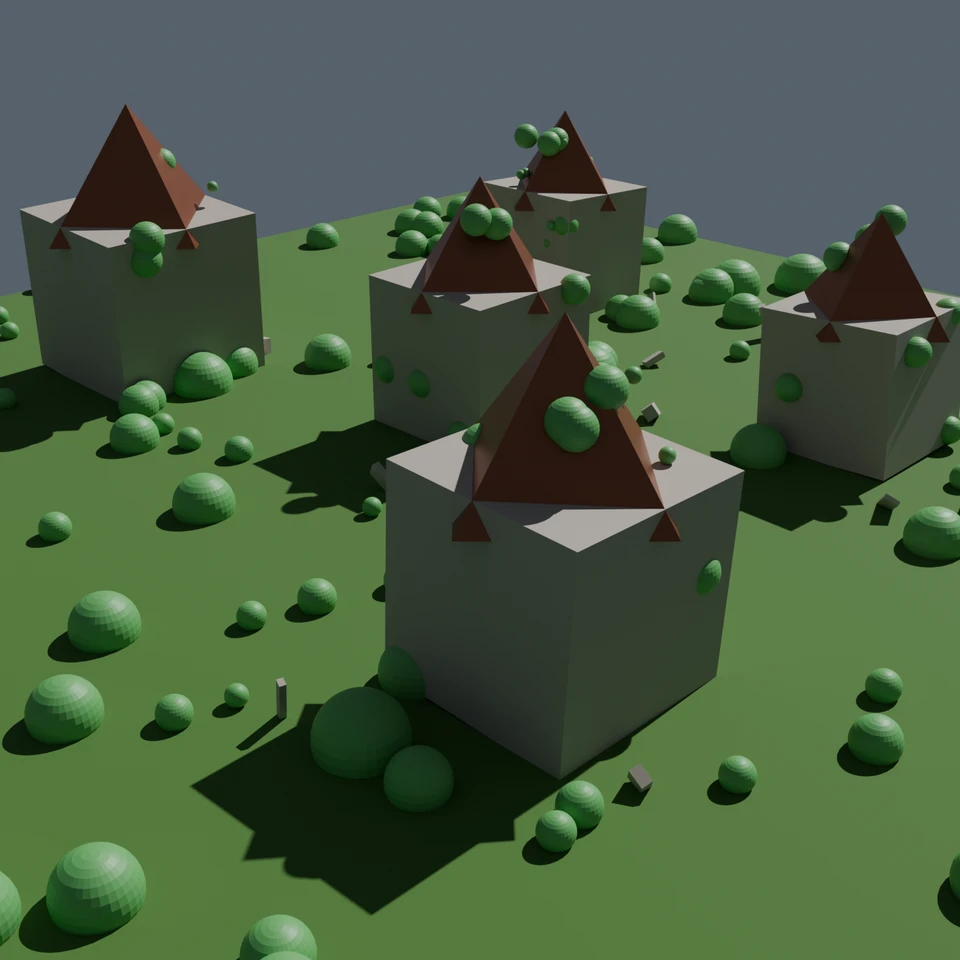
camera + framing set up by the AI contestant
3D Viewport — abandoned-village User Persp
LOADING 3D VIEW
$0.04Cost
148sDuration
9Tool calls
10Turns
Blender 5.1.0MCP 1.22026-07-15
Tokens: 81611/6752Vision: ✓Votes W-L-T: 1-13-0DONE ✓
B-BENCH — TRANSCRIPT Google / Gemma 4 31b It · r1 · 2026-07-15
RUN LOG — abandoned-village · Google / Gemma 4 31b It · r1 · ok
SYSTEM PROMPTthe control — every model on this task got these instructions
PROMPTblender-bench v7HARNESSraw-v2
SHOW FULL PROMPT · 2016 chars
You are participating in Blender-Bench, a public benchmark where AI models complete the same Blender task.

Your result will be compared head-to-head with another model. Anyone on the internet can vote, based only on the published visual outputs they can inspect: the interactive 3D scene and rendered presentation.

Complete the request as well as you can. The benchmark does not prescribe a workflow or visual style; use whichever Blender techniques you consider appropriate. Make the important requirements evident in the published result, save a complete scene, and present the work clearly in every requested output.

The final published capture is rendered by the benchmark from your saved scene using Cycles at 1536 x 1536, 64 samples, denoising enabled, and GPU acceleration when available with a CPU fallback. The saved scene is also exported to GLB with geometry, materials, the contestant camera, and supported lights for interactive inspection. Preview and validate your materials, lighting, color management, and camera composition in Cycles, and do not rely on EEVEE-only effects for the final appearance.

## Harness Instructions

You are operating Blender through the provided tools. The scene starts empty. Build what the user's prompt asks for in the current scene. Work step by step and verify your own work. Before you finish, set up a camera and lighting to frame a single, well-composed presentation image of your result — position and aim the camera, and add or adjust lights so the subject reads clearly. The final benchmark capture overrides the scene render settings and renders in Cycles at 1536x1536, 64 samples, with denoising and GPU acceleration (CPU fallback). Preview and validate materials, lighting, color management, and composition in Cycles; do not rely on EEVEE-only effects. The saved scene is also exported to GLB with geometry, materials, your camera, and supported lights for interactive inspection. When you are finished, reply with the single word DONE and no tool calls.
--TASK abandoned-village: ## Task
Complete the following Blender task:
<task>
An abandoned village slowly reclaimed by nature. Weathered houses with rusted, corroded metal roofs; overgrown foliage creeping up the walls and through broken windows; moss, grass, and vines spreading across the ground and over the rooftops. Convey age, decay, and the quiet return of the wild.
</task>
06:34>>execute_blender_code({"code":"import bpy\nimport random\n\n# Clear scene\nbpy.ops.object.select_all(action='SELECT')\nbpy.ops.object.delete()\n\n# Create a ground plane\nbpy.ops.mesh.primitive_plane_add(size=20, location=(0, 0, 0))\nground = bpy.context.active_object\nground.name = \"Ground\"\n\n# Create materials\n# Ground Material (Mossy Grass)\nmat_ground = bpy.data.materials.new(name=\"Ground_Mat\")\nmat_ground.us…)
06:34<<Error executing code: Communication error with Blender: Code execution error: can't multiply sequence by non-int of type 'float'
06:45>>execute_blender_code({"code":"import bpy\nimport random\n\n# Clear scene\nbpy.ops.object.select_all(action='SELECT')\nbpy.ops.object.delete()\n\n# Create a ground plane\nbpy.ops.mesh.primitive_plane_add(size=20, location=(0, 0, 0))\nground = bpy.context.active_object\nground.name = \"Ground\"\n\n# Create materials\n# Ground Material (Mossy Grass)\nmat_ground = bpy.data.materials.new(name=\"Ground_Mat\")\nmat_ground.us…)
06:46<<Code executed successfully:
07:19>>execute_blender_code({"code":"import bpy\n\n# Let's refine the scene: add some more \"decay\" and \"nature\"\n# Add some fallen beams or debris\nimport random\n\nfor _ in range(15):\n x = random.uniform(-8, 8)\n y = random.uniform(-8, 8)\n bpy.ops.mesh.primitive_cube_add(size=1.0, location=(x, y, 0.1))\n debris = bpy.context.active_object\n debris.scale = (random.uniform(0.2, 1.0), random.uniform(0.05, …)
07:19<<Code executed successfully:
07:21>>get_viewport_screenshot({"user_prompt":"An abandoned village slowly reclaimed by nature. Weathered houses with rusted, corroded metal roofs; overgrown foliage creeping up the walls and through broken windows; moss, grass, and vines spreading across the ground and over the rooftops. Convey age, decay, and the quiet return of the wild."})
07:22<<
07:22imgimage delivered — get_viewport_screenshot
07:26>>execute_blender_code({"code":"import bpy\n\n# Adjust camera for a more evocative, close-up shot of one house and its surroundings\ncam = bpy.data.objects.get(\"Camera\")\nif cam:\n cam.location = (6, 6, 4)\n # Point it towards the center of the village/a house\n import math\n # Looking at (0,0,1)\n target = bpy.types.Vector((0, 0, 1))\n # The built-in way is to use constraints, but we can manually se…)
07:26<<Error executing code: Communication error with Blender: Code execution error: 'module' object has no attribute 'Vector'
07:34>>execute_blender_code({"code":"import bpy\nimport random\nimport math\nfrom mathutils import Vector\n\n# Adjust camera for a more evocative, close-up shot of one house and its surroundings\ncam = bpy.data.objects.get(\"Camera\")\nif cam:\n cam.location = (8, 8, 5)\n # Point it towards the center of the village (0,0,0)\n # Simple rotation to look towards center\n cam.rotation_euler = (math.radians(65), 0, ma…)
07:35<<Code executed successfully:
07:45>>execute_blender_code({"code":"import bpy\nimport math\n\n# Ensure we have a light object named 'Sun' or find it\nsun = None\nfor obj in bpy.data.objects:\n if obj.type == 'LIGHT' and obj.data.type == 'SUN':\n sun = obj\n break\n\nif sun:\n sun.name = \"Sun\"\n\n# Refine camera position and rotation to look at the village\ncam = bpy.data.objects.get(\"Camera\")\nif cam:\n cam.location = (10, -10,…)
07:46<<Code executed successfully:
07:55>>execute_blender_code({"code":"import bpy\nimport math\nimport random\n\n# Final polish of the abandoned village\n# 1. Add some \"broken\" windows/door holes using boolean or just simple cubes\nfor obj in bpy.data.objects:\n if \"House\" in obj.name:\n # Add a \"door\" hole\n bpy.ops.mesh.primitive_cube_add(size=0.5, location=obj.location)\n door = bpy.context.active_object\n door.scale =…)
07:56<<Error executing code: Communication error with Blender: Code execution error: name 'Vector' is not defined
08:04>>execute_blender_code({"code":"import bpy\nimport math\nimport random\nfrom mathutils import Vector\n\n# Redoing the vine loop with proper Vector\nfor _ in range(30):\n house_objs = [o for o in bpy.data.objects if \"House\" in o.name]\n if not house_objs: continue\n target_house = random.choice(house_objs)\n start_loc = Vector((target_house.location.x + random.uniform(-1, 1), target_house.location.y + rando…)
08:08<<Code executed successfully:
08:13ai>DONE
08:13--status: ok · DONE declared
>
LOADING COMPLETE TRANSCRIPT…